The idea of c0re_h came from necessity. It all started with my involvement in Fab Academy. I was mentoring students who brainstormed ideas to build a machine. They finally decided to create a light painting machine, which later came to be known as “Velichapad.”
They had an ambitious mechanical constraint: they wanted a machine with no rigid X-axis cross-beam support, meaning the single light dot needed to appear suspended freely in the air. Two key challenges arose:
- A large CoreXY frame span measuring 1500mm × 1500mm.
- A suspended gantry carrying the light emitter, stabilized purely via tensioned timing belts.
Velichapad light painting platform during machine week
The suspended gantry was inherently prone to deflection. Without a rigid cross-gantry, any imbalance in belt tension caused the toolhead to wobble along the unconstrained axis. To keep everything minimal and within the frame perimeter, we devised c0re_h.
The core_h topology loops timing belts continuously around all four frame borders, constraining motion in both X and Y axes simultaneously. When properly tensioned, the dual loop stabilizes the central toolhead, allowing it to hang suspended without traditional linear guide rails bridging the span.
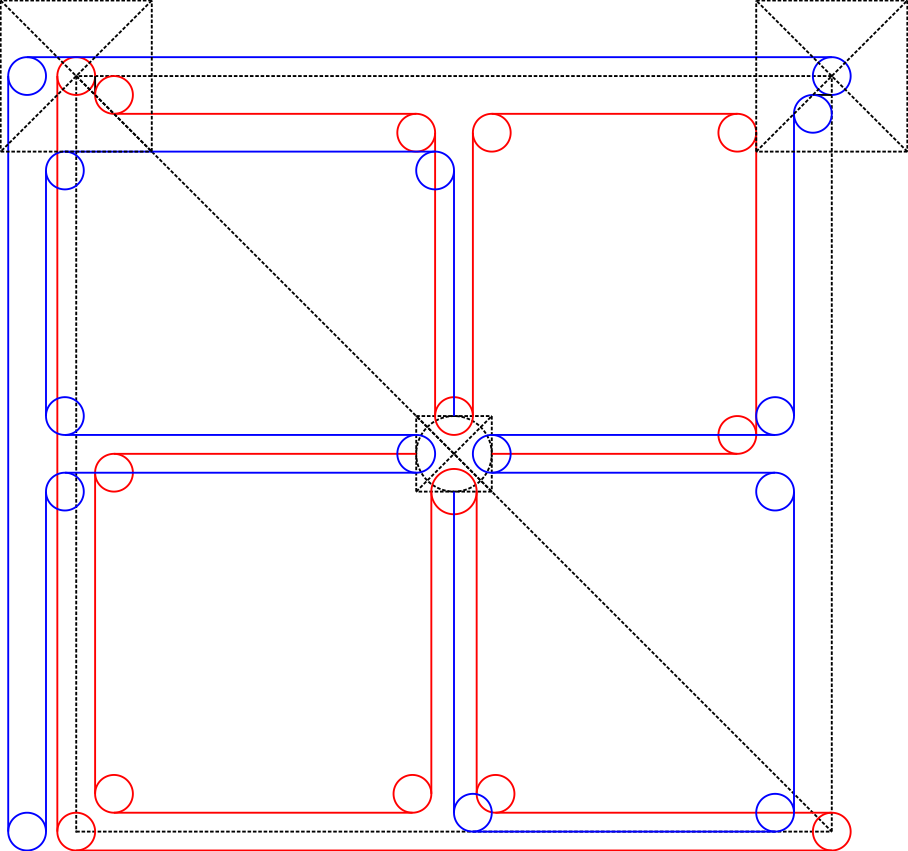
Continuous belt routing schematic and corner gantry positioning
Kinematic Transformation Matrix
ΔX =
1
2
(ΔA + ΔB)
ΔY =
1
2
(ΔA − ΔB)
ΔA = ΔX + ΔY
|
ΔB = ΔX − ΔY
Unlike standard CoreXY which drives two parallel carriages along one axis, this design distributes four corner gantries. It remains theoretically fascinating, with ongoing research into stabilizing out-of-plane Z-axis torsional moments.